
Sri Lakshmikanta Tirtharu
Sri Vyasaraja Matha
Location
PenukondaSri Sathya Sai, Andhra Pradesh
Aradhana Day
Shraavana-Shukla-Saptami
08-Aug-2027
Brindavana Year
1594
Guru (Preceptor)
Shishya (Disciple)
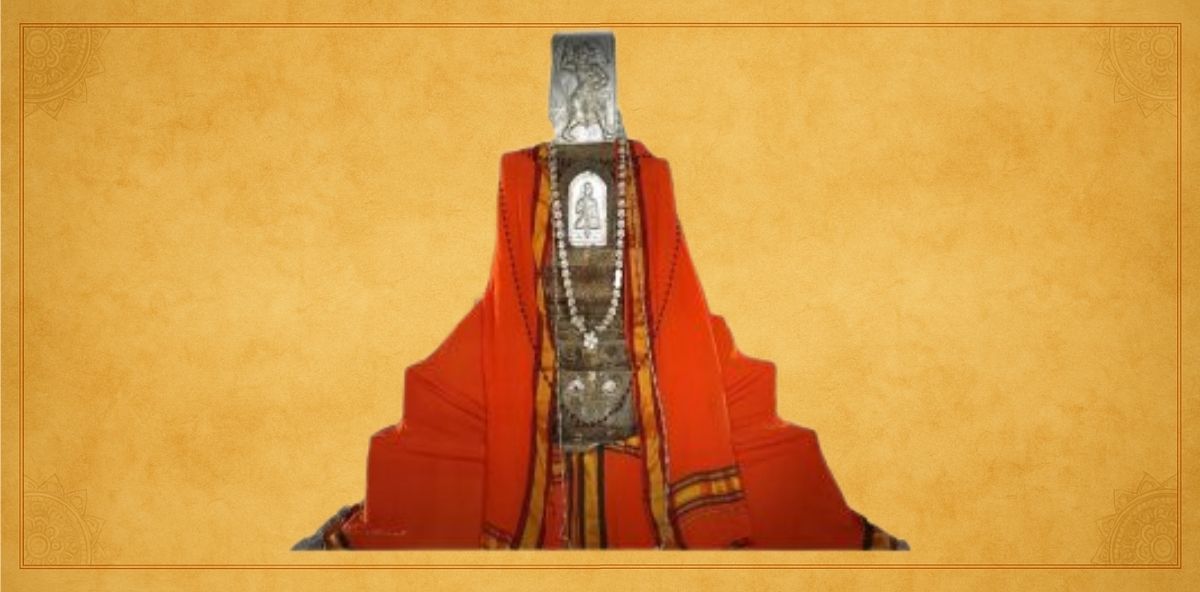
📖 About Sri Lakshmikanta Tirtharu
Sri Lakshmikanta Tirtharu was ordained the 15th Peetadhipati by Sri Rama Tirtha. Sri Lakshmikanta Tirtha has the distinction of having been one of the few direct disciples of Sri Vyasaraajaru in his Purvashrama. Others were Sri Srinivasa Tirtha, Sri Rama Tirtha, and Sri Sripati Tirtha. He belongs to Haritasa Gotra, Yajus Shaka, Aravattu Hokkalu, Shashtika Vamsha.
His Purvashrama Nama seems to have been one of the following three: Gopalakrishnacharya, Venugopalakrishnacharya, or Vedavyasacharya. He seems to have been a cabinet advisor to the Vijayanagara emperors until its demise in the Battle of Talikotta and assisted with the relocation of the empire to Penukonda. Shortly afterward, he was ordained to the fourth order Sanyasashrama and given the responsibility of the Peetha by Sri Rama Tirtha.
Subsequently, Sri Swamiji chose Penukonda not only for political reasons but also to continue serving the 360 Hanuman idols that were consecrated by Sri Vyasaraaju. Historically, this place was a Jain stronghold even before the time of the Vijayanagara empire. Sri Vyasaraajaru acceded to the request of local scholars, camped for a year’s time here, debated and defeated the Jain scholars, and re-established Sanatana Dharma. Tradition holds that Sri Vyasaraajaru consecrated one Hanuman idol every day to commemorate each victory and also established a Vidyapeetha in this place, which had become defunct. The responsibility of recommencing the Vidyapeetha was the other reason for Sri Swamiji to choose this place, where a few thousand students used to have their shastric education.
Two adjectives have been used in the above shloka to describe the Swamiji’s qualities. The first one is Bhutadosham, which describes his extreme affection and patronage of scholars irrespective of their affiliations. Scholars used to visit, exhibit their scholarship on scriptures, and were profusely rewarded.
It is known from tradition that the Durbar event in the Srimatha had ceased after the time of Vyasaraajaru and was rejuvenated during his time, and it has continued to this day. He was a great tapasvin, and his blessings had the power to convert a pauper into affluence and reduce an arrogant one to a pauper!
He is not known to have extensively travelled, perhaps indicative of the political turmoil at that time, but stayed in this place for a period of ten years and imparted knowledge to quite a few monks of the fourth order, bidi Sanyasins, on advanced texts such as Vyasa Traya – Tatparya Chandrika, Tarka Tandava, and NyayAmruta.
Tradition records that scholars used to recite Chandrika at the time of his morning ablutions, NyayAmruta during the time of Bhiksha Sweekara, and Tarka Tandava during the time of Tottilu Puje – in other words, there was a well-established system to ensure that various facets of Sanatana Dharma were practiced and appropriately compensated to ensure continuity.
There are enough examples to prove that both spiritual and material benefits were accrued by sincerely performing Seva at his Sannidhana. The saint is accredited with the inheritance of the currently existing Balaganadu sect of Madhva followers.
Post the Brindavana Pravesha of this saint, Kambaluru Ramachandra Tirtha performed his Chaturmasya in 1626 AD in this very place. Later, Sri Vidyavallabha Tirtha seems to have visited this place.
There are two versions: Lakshanaryamaham and Lakshmanaryamaham. Sripadangalavaru has indicated that the latter is more appropriate and observed that the word has to be split as per grammatical rules as Lakshmanarya + Maham. Lakshmanarya is Lord Rama and Maha means to worship. Hence this can be interpreted as the saint that worshipped Moola Pattabhirama, whose blessings are capable of converting a pauper (Bhikshukan) into a millionaire (Laksheshan).
Note: This shloka, as well as the charama shloka of Sripati Tirtharu (the saint’s successor), appears in the Nyayasudha Tippani of Kambaluru Ramachandra Tirtharu .
📜 Charama Sloka
लक्ष्मीकांतगुरुं वंदे लक्ष्मणार्यमहं सदा | रक्षितान् स्वेन कुर्वाणं लक्ष्मीशान् भिक्षुकानपि ||
Note: The slokas are curated from various matha websites using AI and may contain inaccuracies.